|
|
|||||||||||||||||||
| � LA NGUYEN 2000 |
|
||||||||||||||||||
|
Mechanics of skating Skating,
as we all know, is a vital part of ice hockey. To be a good skater, it
is required that we have good technique and a reasonable amount of
physical strength. As
presented in the previous section, the slipperiness of the ice is due to
its almost frictionless surface. The blade of the skate can glide
through the ice with ease. Many speculations have been made prior to
Professor Gabor Somorjai's (a chemist) research on this topic.
Scientists could not determine whether it was the pressure or the
friction that generated the water lubricant which was believed to be
required for skating, the studies of Somorjai proved that it was neither
the pressure nor the friction that created the lubricant, he proved that
it was not the water that made us able to glide on the ice. In fact, he
stated that we skated on vibrating molecules. Professor Gabor Somorjai,
and his team used the latest methods to examine the surface structure
and composition of the atoms and molecules that make up the ice. These
highly sophisticated methods were meant to be used for specific
applications such as studying the surface of materials that can be used
for magnetic disk drives and many more. Somorjai used these same
techniques to examine ice. His discovery was rather troubling. Somorjai
stated that, "the structure we determined was an almost impossible
structure, indicating that every second water molecule on the surface
was missing. Since that was not possible, we decided to go back and
understand why [this was the case]." After further study,
Somorjai's team found that the "missing" water (or ice)
molecule was indeed there, but it was vibrating so rapidly that it was
invisible to the method they were using. Once Somorjai and his team
found this out, they could change the conditions to further study these
molecules. After
additional studies, Somorjai discovered that the molecules tend to
behave like a liquid's molecules, except that they only move up and down
and not sideways. This is an important distinction. If they moved side
to side, the "liquid-like" layer would literally become
liquid. It is for this layer that is thought to make the ice slippery. In
order to move around on the ice, it is required that a player digs into
the ice and pushes off from the surface. Newton's third law, states that
"for every action there is an equal and opposite reaction". By
using our weight and strength we push down on the ice, which in reaction
pushes us forward. The sharp edges on the skate's blades can dig into
the ice to let the player accelerate quickly or stop at any crucial
moment in the game. By using the blade, we can move faster. The friction
between the blade and the ice is very minimal since the surface of the
ice is already almost frictionless and since only the skate's blade is
actually in contact with the ice, the surface of contact between the ice
and the player is extremely minimized and hence would lower the friction
causing the player to be able to move faster with less force acting on
him in the opposite direction. It
has already been demonstrated that a player can reach the speeds in
excess of 32 km per hour on ice. Some speed skaters have been clocked at
over 48 km per hours. Strength and mechanics are the perfect combination
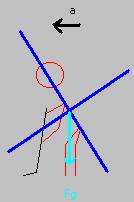
to maximize the speed of a skater. When accelerating, players dig their
skates into the ice, by digging into the ice the player gets a surface
from which he can push off (a surface from which he can exert a force
on) and move forward. Not only do they use strength to push forward,
they also lean forward. By leaning forward, gravity pulls down on their
center of mass, which is inclined, this cause gravity to pull them
forward. The force exerted on the player by gravity is separated into
two directions, in the direction of the movement, which is forward-down,
and in the direction opposing the normal force which is inclined since
the player is also inclined.
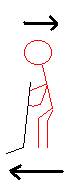
It
is important that they only do this when they are accelerating otherwise
they would fall over. When the accelerate forward the friction caused by
the air and since the lower part of the body accelerates faster then the
upper body, the upper body is moved forward but slower then the lower
body and this causes our upper body to move backwards compared to our
lower body. Obviously, we accelerate just enough to keep our upper body
at reasonable inclination to be able to stay standing and not fall
backwards.
By digging deep enough into the ice and leaning forward they can maximize their skating speed and score many goals for their team. A combination of strength and techniques can determine whether a player can skate fast or not. In this case it can determine if the team wins or loses. Skating plays a vital role in this sport and it is the duty of a player to maximize his speed so that his team can win.
|
|
|||||||||||||||||