|
|
|||||||||||||||||||
| � LA NGUYEN 2000 |
|
||||||||||||||||||
|
Player
shooting (the
slap shot) It
happens again and again in hockey. A player streaks down the wing and
winds up for a slap shot and before the goalie can move, the net behind
him bulges. It's one of the most exciting moments in a game and yet it's
over in the blink of an eye. Most of us think the slap shot has existed
since the creation of hockey but to our surprise, the slap shot is a
relatively recent development in the game of hockey. It is said that
Bernie "Boom Boom" Geoffrion "invented" the shot in
the 1950s, but Bobby Hull popularized it by slapping his way to several
50-goal seasons in the 1960s. Today, the slap shot is an essential
weapon for all players. Even so-called defensive defensemen are expected
to be able to serve up an impressive canon-like shot. The slap shot is
without a doubt the fastest and strongest shot in hockey. It has been
proven by a defenseman Al Iafrate who served up a shot that was clocked
at well over 160 km per hour. The
secret in the slap shot, according to defenseman Doug Bodger, is
"mostly technique and that the power comes from a weight
transfer". The energy needed to make a slap shot is generated by
the weight transfer from the persons back leg through the stick in his
hands. The
slap shot consists of 6 steps. �
First of all, there is the preparation, the positioning, and the
body stance. �
Secondly, the windup, it consists of a player drawing his stick
back by raising his posterior arm and rotating both his trunks and hips
to raise the blade of his stick as far behind and above him as possible.
The further he winds up, the more strength the shot will have. �
Third, the downswing, the player rotates his hips, trunk and
shoulder, causing the stick to accelerate forward and downward until the
blade comes in contact with the ice approximately four inches behind the
puck. This is done to cause the stick to bend when it reaches the puck,
the curved stick releases the energy caused by the bending of the stick
as it snaps towards the puck and as the swing follows through, the rest
of the energy transferred by the weight, is then released in a single
blow. �
Forth, "loading the stick", At this point, the shooter
continues to apply pressure on the stick by pushing the lower hand
against the shaft and holding the upper end of the stick close to the
body. This causes the shaft to curve and thereby store energy. The
height of the lower hand on the shaft is critical. If it is too high,
the shooter will not be able to bend the shaft enough to maximize energy
load, if it is too low, not as much energy will be transferred to the
puck. The best compromise position is set by a variety of other factors.
This step is the most important stage of the slap shot because so much
of the velocity is generated here. �
Fifth, the impact. As the movement continues, the blade catches
the puck, releases energy and accelerates the puck as it clears the ice.
Ideally, the puck is struck by the heel of the blade, which is the
"sweet spot" of a hockey stick: because it is closer to and in
line with the shaft it offers better energy transfer. The further out on
the blade, the more twisting force, there is. That's why players can
take flick shots off the tip of the blade that rise quickly but lack the
speed of shots taken at the heel. During this stage of the slap shot,
the shooter rotates the shaft forward so that the blade turns over until
it faces down toward the ice. This motion increases the acceleration of
the puck by keeping the force on it instead of letting it roll off an
open-face blade. �
And the last step, "the follow-through", The player
allow the body to rotate and move forward so the stick moves forward and
upward in front of the body. Not all the energy built up previously can
be transferred so the body must reabsorb it and by following through the
movement, the shooter reabsorbs it. If he did not reabsorb it, he would
fall over or even risks doing some damage to his muscles. The
stick is made to be flexible in order to use torque movement to make
stronger shots. After testing the resistance of a fiberglass hockey
stick with a wooden replacement blade, the people at The Exploratorium's
Science of Hockey discovered that it takes about one ton of force to
break it. We can observe in the hockey games that many sticks are broken
after the players make slap shots. This only shows how strong a slap
shot is. The
puck's shape is an element that helps the accuracy of the slap shot; its
flat surface prevents it from bouncing a lot because the puck is in some
sort, aerodynamic, the air passes above and under it, maintaining it in
the horizontal position, hence providing more friction on the vertical
level and maintaining it at ground level. The NHL rulebook states that
pucks must be one inch thick and three inches in diameter and weigh
between five and one-half and six ounces. That�s the same puck
normally used by all hockey players, except younger kids, who often use
smaller, lighter pucks. Puck shooting works in the same way as a
projectile. The force acting on it is caused by the energy transfer from
the stick to the puck and an other force that acts on it is gravity
which pulls the puck down and giving it a bit of acceleration as it
falls if it is lifted (a= 9.8m/s) and an opposing force which is
friction generated by the air on the puck. The initial velocity can be
calculated by using the formula: Dx/t = vxo . Equations
that describe the motion of a projectile are:
The
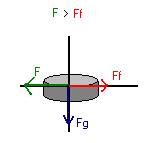
force acting on the puck after it has been shot are:
F: Force from shot Ff: Friction from air Fg:
Force exerted by gravity In
the NHL, they use frozen pucks. When a puck is frozen, a thin layer of
ice forms on it, reducing the friction between the puck and the ice
surface. After freezing, pucks slide better, go faster and bounce less,
making it easier to puck handle, pass and shoot. This factor enhances
game play and entertains the millions of hockey fans. The
slap shot is an essential weapon in this game. With the proper
technique, speed and strength, these shots are practically impossible to
stop if they are shot from a close enough range. These shots are the
strongest and most interesting of the types of shot used in hockey.
|
|
|||||||||||||||||