|
|
||||||||||||||||||||||||||||||||
| � LA NGUYEN 2000 |
|
|||||||||||||||||||||||||||||||
|
Impacts
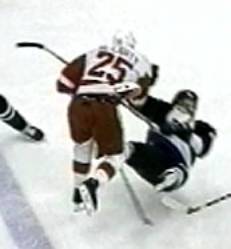
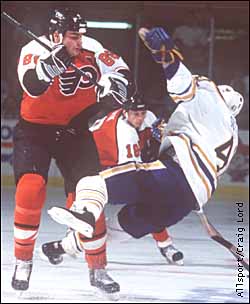
and collisions Some people watch hockey because they just want to see people get body checked others play hockey just to be able to deliver bone-breaking hits. So collisions are part of the game! The faster and bigger player will deliver more force than a slow and small player. Momentum
is defined as the MASS of an object times its VELOCITY, or P=mv. There
is also impulse involved in hockey, it is known as simply the change of
momentum, and is formally defined as the product of the force exerted to
change the momentum and the time it took to do that (I=Ft). So the two
formulas involved here are:
MOMENTUM Size
of a player:
Homer and Apu are skating at 10m/s. Homer weighs 100Kg and Apu weighs
60Kg pounds. They collide; guess who will end up lying on the ice.
So
there is a 400 Kilogram-meter per second difference between Homer and
Apu. Homer has a significantly larger momentum than Apu because he is
heavier. So Homer will be able to flatten Apu on the boards.
SIZE
DOES MATTER! Speed
of player Bart
and Millhouse each weigh 35Kg. Bart is skating at 13m/s and Millhouse is
skating at 2m/s. Millhouse is going slow because he doesn�t know how
to skate. Bart skates up to him and hits him. Will Millhouse fall on the
ice?
There
is a 385 Kilogram-meter per second difference between Bart and Millhouse.
So Millhouse will end up on lying on the ice. IMPULSE What
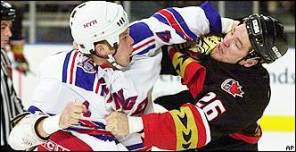
happens if Homer decides to add a punch to his body check on Apu? The
force of the punch is 500 Newtons and he exerts this force for 1 second.
P=400kg
x m/s So
the total change in momentum on apu is 900kg x m/s. Therefore Homer just
made his body check more than 2 times more powerful. To be exact Homer
just increased his hit power by 55.5%.
Example
where Impulse may occur.
|
|
||||||||||||||||||||||||||||||